
All that Jazz: memories from the Pescara Jazz Festival
by Anna Battista
 Confusion. Confusion of sounds. Confusion of times and events. A saxophone
is playing, a trumpet follows, a piano joins in, drums beat and while the
sounds merge in the air, revolutions revolve and the world changes, for
better or for worse. Men fight for their rights, civil struggles rage in
the streets, wars break and peace is mended like a broken heart while a
spaceship crosses the astral space and discovers a new planet. And this
mish-mash of sounds is the right soundtrack for these scattered events
which, though disparate and fundamentally diverse, have some kind of unity.
Like all the instruments playing together, though their sounds are
singularly unique, the rhythm they produce is one. That was the principle
behind John Coltrane's "Ascension"; that's also the principle behind lots
of music festivals, just letting lots of passionate artists play, creating
a wide range of sounds for passionate people, releasing all the rhythms in
a single ball of energy to throw into the sky. That's the power of unity,
made by people, made by musicians, made by instruments, made by festivals
and made by jazz.
Confusion. Confusion of sounds. Confusion of times and events. A saxophone
is playing, a trumpet follows, a piano joins in, drums beat and while the
sounds merge in the air, revolutions revolve and the world changes, for
better or for worse. Men fight for their rights, civil struggles rage in
the streets, wars break and peace is mended like a broken heart while a
spaceship crosses the astral space and discovers a new planet. And this
mish-mash of sounds is the right soundtrack for these scattered events
which, though disparate and fundamentally diverse, have some kind of unity.
Like all the instruments playing together, though their sounds are
singularly unique, the rhythm they produce is one. That was the principle
behind John Coltrane's "Ascension"; that's also the principle behind lots
of music festivals, just letting lots of passionate artists play, creating
a wide range of sounds for passionate people, releasing all the rhythms in
a single ball of energy to throw into the sky. That's the power of unity,
made by people, made by musicians, made by instruments, made by festivals
and made by jazz.
Surely jazz connoisseurs are well aware of the Pescara Jazz Festival, but not everyone is aware of how it all started, of how at the back of it there was just a lot of passion and fandom. The seeds of the Pescara Jazz Festival were sown when in 1962 a group of friends decided to invite a by then very young legendary saxophonist Leandro "Gato" Barbieri to play. "Gato Barbieri's concert was an isolated episode which already foresaw the pace we wanted to set," Lucio Fumo, art director of the Pescara Jazz Festival recollects in tranquillity, while a beam of sunlight intrudes in his office settled right in the centre of Pescara in this bright March morning. "We were a group of passionate friends who travelled around Italy and Europe going to jazz concerts and, at a certain point of our wanderings, we wondered why we couldn't try to organise in Pescara those concerts," he remembers, "So we did this attempt with Gato Barbieri, who at the time was very young and had just arrived in Italy where he had just started his career. We did this concert with our money and it cost us L.40.000 liras and we did it on the first floor of the Guerino Restaurant," the director smiles, continuing: "Then we decided to found a jazz club but for two or three years everything remained still. In 1967, after we spent a few years trying to organise something, we decided to found a circle for music friends. This circle was also interested in classical music, but actually the classical music was a sort of cover to organise jazz gigs, otherwise we would have never managed to do exclusively jazz concerts because people didn't like jazz a lot in Italy. The first series of concerts was opened by a group of classical pianists, followed by Stephane Grappelli, Franco Cerri, Enrico Intra, Giovanni Tommaso and after a while Kenny Clarke and Hampton Hawes came, the latter during the only tour he did in Italy before dying. Rapidly in the same year, 1967, the circle of jazz friends turned into the Society for Theatre and Music and we opened the season with a concert by Oscar Peterson and Coleman Hawkins and the following year we had Duke Ellington. So we began organising music concerts and theatre shows big style."
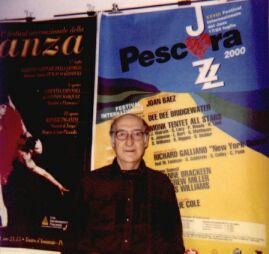 "During the first years we had great artists
such as Sarah Vaughan and many others and, as in 1969 the local Tourist
Office was looking for a manifestation to launch Pescara on an
international level, they thought it would have been a good idea to give
some funds to the festival and support it, but nobody ever imagined that we
would have got to this level. It seemed like making a bet which in the end
we won as the years that followed proved. For example, in 1970 we had
Maynard Ferguson, Teddy Wilson, Shelly Manne and what was most important is
that most of them came exclusively to Pescara because they were directly
contacted as there wasn't all this chain of festivals in Europe yet. We can
actually boast of having been the first Italian town with a proper jazz
festival. In 1970 Duke Ellington came back and in the years 1971, 1972 and
1973, Pescara was considered one of the four or five most prestigious
festivals in Europe: the covers of the glossy jazz magazines listed the
Montreux Festival, the Newport Festival, the Pescara Festival and the Nice
Festival. The Festival continued to grow up though it went through a
negative period during the '70s. The youth movement overwhelmed the Pescara
Jazz Festival and the Umbria Jazz Festival: young people started protesting
saying that they wanted music for free, though I remember that there were
kids who had paid the ticket to get in, but they jumped the barriers all
the same just to show that they were getting in for free. Incidents
followed and we decided to suspend the festival in 1976. Only after four
years, in 1981, a year before the Umbria Jazz Festival was able to open
again, we started again our own thing. It was then that we had the greatest
success, 12.000 people came to the concerts and we even had to do a couple
of concerts at the Stadium. We were back on board big style once again: in
1981 we had Woody Shaw, Art Pepper, Stan Getz, Dizzy Gillespie and Count
Basie's orchestra. The Festival survived the '80s and, when we got to its
25th anniversary, the local offices for the promotion of the region, got so
enthusiastic about the manifestation that it was heavily promoted and went
back to its previous glory. In the last four years from 1996 till last
year, the Festival audience redoubled and we decided to meet the audience's
requests, opening the show with artists such as Joan Baez, James Taylor and
Al Jarreau who, to tell the truth, don't have much to do with jazz. Anyway,
we never betrayed the Festival's cult for jazz on the whole: 90% of the
concerts we do are jazz concerts."
"During the first years we had great artists
such as Sarah Vaughan and many others and, as in 1969 the local Tourist
Office was looking for a manifestation to launch Pescara on an
international level, they thought it would have been a good idea to give
some funds to the festival and support it, but nobody ever imagined that we
would have got to this level. It seemed like making a bet which in the end
we won as the years that followed proved. For example, in 1970 we had
Maynard Ferguson, Teddy Wilson, Shelly Manne and what was most important is
that most of them came exclusively to Pescara because they were directly
contacted as there wasn't all this chain of festivals in Europe yet. We can
actually boast of having been the first Italian town with a proper jazz
festival. In 1970 Duke Ellington came back and in the years 1971, 1972 and
1973, Pescara was considered one of the four or five most prestigious
festivals in Europe: the covers of the glossy jazz magazines listed the
Montreux Festival, the Newport Festival, the Pescara Festival and the Nice
Festival. The Festival continued to grow up though it went through a
negative period during the '70s. The youth movement overwhelmed the Pescara
Jazz Festival and the Umbria Jazz Festival: young people started protesting
saying that they wanted music for free, though I remember that there were
kids who had paid the ticket to get in, but they jumped the barriers all
the same just to show that they were getting in for free. Incidents
followed and we decided to suspend the festival in 1976. Only after four
years, in 1981, a year before the Umbria Jazz Festival was able to open
again, we started again our own thing. It was then that we had the greatest
success, 12.000 people came to the concerts and we even had to do a couple
of concerts at the Stadium. We were back on board big style once again: in
1981 we had Woody Shaw, Art Pepper, Stan Getz, Dizzy Gillespie and Count
Basie's orchestra. The Festival survived the '80s and, when we got to its
25th anniversary, the local offices for the promotion of the region, got so
enthusiastic about the manifestation that it was heavily promoted and went
back to its previous glory. In the last four years from 1996 till last
year, the Festival audience redoubled and we decided to meet the audience's
requests, opening the show with artists such as Joan Baez, James Taylor and
Al Jarreau who, to tell the truth, don't have much to do with jazz. Anyway,
we never betrayed the Festival's cult for jazz on the whole: 90% of the
concerts we do are jazz concerts."
Apparently the Festival always received positive reviews from music magazines and music journalists, except at the end of the '70s, "In the years 1975 and 1976, during the youth movements' protests, some left wing critics defined the Pescara and the Umbria Jazz Festivals as 'fascist festivals', because we invited American artists," Lucio Fumo explains, "But it was a fake polemic, it was only a pretext which didn't stand its ground: after all if you invited Dizzy Gillespie and Charles Mingus you weren't a fascist as they were the jazz stars of the time. Nowadays we have always had wonderful articles about the festival also by number one jazz writers. We've especially been praised because we always organise interesting and exclusive stuff. For example, last year we had a piano summit which was an exclusive production of our festival. We put together three pianists and we did a gig and those who wanted to see them playing had to come here. In the past we did a guitar summit and another piano summit with Joanne Brackeen, Mulgrew Miller and James Williams and we did tribute nights dedicated to Charlie Parker to celebrate the 20th years of the release of Parker's record with the string orchestra and we invited a string orchestra and the pianist Walter Bishop who had taken part in the original recordings with Parker. In the same way, we did nights in praise of Charles Mingus with the Mingus Big Band." But the Festival doesn't only celebrate the legends of the past, it also helps the future generation of musicians to find their own way. A few years ago the Festival organisers decided to start a workshop for young people, as Lucio Fumo remembers: "Three years ago we started a seminar for young people: three young people are chosen by the local teachers to go for one week to the Chicago Columbia College where they have a unique experience."
 Though proud of the Festival as a whole, Lucio Fumo states that there are
two particular artists he loved and still loves and who would pay tribute
to in every edition of the Festival. "The two people who struck me more were
Charles Mingus and Duke Ellington," he claims, "Ellington came here for the
first time one winter. He arrived by car with a friend of mine who went to
meet him in Rome, whereas his band came by bus from Rome. As the highway
from Rome to Pescara wasn't still complete they had to pass through the
mountains, at the time Pescara was unknown and the Festival still hadn't
started. They arrived at the Massimo Theatre, which at the time contained
barely a thousand of people, and it was so crowded that there were even
people standing. The orchestra started playing behind the curtains and when
they opened them the band saw 2000 people standing in front of them
clapping. The concert went on till 3.30 a.m., then all the older members
stopped playing and Ellington kept on playing for ten extra minutes. After
the concert we went to eat with Paul Gonsalves, who was drunk, and he told
us that on the bus they kept on wondering 'Who knows where we're going to
play, perhaps some kind of small village lost in the mountains...' Then
when they arrived and saw those people, they were rather shocked. Paul
Gonsalves said that Johnny Hodges, who played the alto sax and who was the
leader of the band apart from Ellington, was always dozing off and when he
saw the enthusiastic audience he turned to the others and said 'Hey men,
tonight we have to play!' "
Though proud of the Festival as a whole, Lucio Fumo states that there are
two particular artists he loved and still loves and who would pay tribute
to in every edition of the Festival. "The two people who struck me more were
Charles Mingus and Duke Ellington," he claims, "Ellington came here for the
first time one winter. He arrived by car with a friend of mine who went to
meet him in Rome, whereas his band came by bus from Rome. As the highway
from Rome to Pescara wasn't still complete they had to pass through the
mountains, at the time Pescara was unknown and the Festival still hadn't
started. They arrived at the Massimo Theatre, which at the time contained
barely a thousand of people, and it was so crowded that there were even
people standing. The orchestra started playing behind the curtains and when
they opened them the band saw 2000 people standing in front of them
clapping. The concert went on till 3.30 a.m., then all the older members
stopped playing and Ellington kept on playing for ten extra minutes. After
the concert we went to eat with Paul Gonsalves, who was drunk, and he told
us that on the bus they kept on wondering 'Who knows where we're going to
play, perhaps some kind of small village lost in the mountains...' Then
when they arrived and saw those people, they were rather shocked. Paul
Gonsalves said that Johnny Hodges, who played the alto sax and who was the
leader of the band apart from Ellington, was always dozing off and when he
saw the enthusiastic audience he turned to the others and said 'Hey men,
tonight we have to play!' "
This memory is just the confirmation that the Pescara Jazz Festival has got a unique characteristic: all the musicians who play here feel at their ease in a friendly and happy environment. "That's because the group of friends who founded the festival remained at the core of it," Lucio Fumo explains, "And we are so passionate about jazz that we go and fetch the musicians, we go shopping with them if they need anything. A journalist once entitled a piece of writing about the Festival 'Jazz and Kindness' summarising the genuine spirit of the manifestation in those words."
As a proof of the kindness and passion of the Festival organisers, Lucio Fumo mentions his meeting with Duke Ellington. "I remember having my picture taken with Duke Ellington when he came to Pescara. A year later, a year before he died, he came back to Italy, but to Bologna. I went there to see him and I went backstage to have my picture signed. Joking he said, 'Where's my copy of this picture?' and I told him I would have sent it to him, then while I was spelling my name for him, he said 'When are you going to take me back to Pescara?' I was shocked! I mean he played 300 gigs a year and he met thousands of people and I had met him only once and he remembered me and the town where I came from. It was amazing, he was really a…duke!"
Lucio Fumo has got special memories of Charles Mingus as well. "In July 1972, Ben Webster was expected to play a concert at the festival, but he never got to the gig in time, so I arranged to give Webster's agreed $500 dollars to Charles Mingus if he played longer. Mingus consented to play in his place and everything went well. Then, at the end of the concert, when we were going away, Mingus' son called his father and said 'Hey dad, Ben is here!', and Ben Webster, caked in mud, appeared. Mingus asked me to give the $500 dollars to Webster. It was OK with me, but Mingus had already told his band that he would have distributed the extra money at the end of the night. One of the members of his band, Bobby Jones, a small man, started complaining that he wanted the money. After the gig we went to do a jam session at the Esplanade Hotel and the guy kept on mumbling that he wanted the money. Mingus was really tired of listening to him, so he got Bobby Jones, Ben Webster, Lilian Terry and me and we went out following him. We went on the riviera at 5 a.m. and Mingus took Bobby Jones by the lapels of his jacket, suspended him in the air and told him 'Now tell Ben what you want!' Jones mumbled 'Nothing!' and Mingus let him go."
Lucio Fumo concludes with a smile lost in those years, but then he adds, "I often hear from Mingus's wife Susan, also because she came here in Pescara for the Italian debut of 'Epitaph', then she came back here for the tribute night to Mingus. I always had a good relation with her because I helped her while she was in Pescara and she was really very very happy to debut with 'Epitaph' here, I must admit that that was one of the best events of the Festival, we had journalists from all over Italy coming here and we also had a big press conference with Susan. I also met Susan twice while I was in New York. One day I went to her house to have dinner with her and there was a show in Broadway near where she lived about Billy Holiday's life. Billy Holiday and Charlie Parker are for me two legends so I told Susan I wanted to see it. We had some dinner at her house and then we went to the show. Then on a Thursday night we went together to see an orchestra playing at the Café Society. At the end of the gig the musicians went around the tables asking for some money, $30-40 dollars to play Mingus' music."
 In Charles Mingus's 'from rags to jazz' autobiography Beneath the Underdog,
the musician recounts the day when a music critic asked him how he would
have defined the music he played "There once was a word used - swing. Swing
went in one direction, it was linear, and everything had to be played with
an obvious pulse and that's very restrictive," Mingus explained, continuing:
"But I use the term 'rotary perception'. If you get a mental picture of the
beat existing within a circle you're more free to improvise. People used to
think the notes had to fall on the centre of the beats in the bar at
intervals like a metronome, with three or four men in the rhythm section
accenting the same pulse. That's like parade music or dance music. But
imagine a circle surrounding each beat - each guy can play his notes
anywhere in that circle but the original feeling for the beat isn't
changed. If one in the group loses confidence, somebody hits the beat
again. The pulse is inside you. When you're playing with musicians who
think this way you can do anything. Anybody can stop and let the others go
on. It's called strolling. In the old days when we got arrogant layers on
the stand we'd do that - just stop playing and a bad musician would be
thrown."
In Charles Mingus's 'from rags to jazz' autobiography Beneath the Underdog,
the musician recounts the day when a music critic asked him how he would
have defined the music he played "There once was a word used - swing. Swing
went in one direction, it was linear, and everything had to be played with
an obvious pulse and that's very restrictive," Mingus explained, continuing:
"But I use the term 'rotary perception'. If you get a mental picture of the
beat existing within a circle you're more free to improvise. People used to
think the notes had to fall on the centre of the beats in the bar at
intervals like a metronome, with three or four men in the rhythm section
accenting the same pulse. That's like parade music or dance music. But
imagine a circle surrounding each beat - each guy can play his notes
anywhere in that circle but the original feeling for the beat isn't
changed. If one in the group loses confidence, somebody hits the beat
again. The pulse is inside you. When you're playing with musicians who
think this way you can do anything. Anybody can stop and let the others go
on. It's called strolling. In the old days when we got arrogant layers on
the stand we'd do that - just stop playing and a bad musician would be
thrown."
Nowadays Mingus and the other jazz players' magic music can be perfectly heard on CDs, also on the live ones recorded in Pescara and released a while back. Indeed the Festival managed to promote itself also releasing two albums of live sessions. The first album, AfterHours Vol.1 recorded between 1972 and 1973, contains live music from Charles Mingus, Ben Webster, Kenny Drew, Roy Brooks, John Lewis, Dexter Gordon, Dave Liebman and Charlie McPherson; the second album, After Hours Vol.2, recorded in 1976, contains tracks by Sam Rivers, Joe Daley and Sidney Smart. "These are private registrations we did for ourselves," Lucio Fumo explains, "They were mostly done at the Esplanade Hotel, after the gigs and many of them are that good since they are taken from a little distance. Actually for the 15th anniversary of the Festival we decided to release a CD and we did a first choice of the best tracks we had. Then since we realised we had a lot of stuff, last year we thought to release some other stuff on a local label called Ecam. By now we have already released two of them but we are thinking of releasing a third volume and to re-release the CD printed 10 years ago for the 15th anniversary."
The second CD, the one featuring Sam Rivers, also contains a funny story: apparently while Sam Rivers was jamming someone from the audience joined him. "Sam Rivers played 'African Call' with one of his sideman at the Esplanade Hotel," Lucio Fumo remembers, "Then someone from the audience asked him to play 'Blue Moon' and he played its chorus, but he couldn't remember the first part, so a member of the audience stood up and sang it. This shows that he was a famous musician because he rode the political and social moment he lived in, but he wasn't technically flawless. He completely ignored 'Blue Moon'! We also have some recordings from the Art Ensemble from Chicago, but only short fragments. They painted their faces and made a revolution on the stage, then when we went to play at the Esplanade Hotel they started playing Parker's stuff, saying that that was the kind of music they liked but they had to play another kind of music to earn a living, well, at least they were able to play!"
I wonder if in their archives they have anything from Sun Ra, but the answer is negative. "We don't have anything from Sun Ra because his concert was done at the stadium and it would have been difficult to record it. Besides his music is spectacular and choreographic and it would have been difficult to tape as it's a sort of continuous movement…" I also wonder if there are any chances of seeing the Arkestra playing again at the Festival. "Last year they asked us if we wanted to invite the Arkestra," Lucio Fumo confesses, "But I think that these orchestras who play without their leaders don't last long. For instance, the soloists of Ellington's band died, so there isn't much to see or rather to hear. Sun Ra was a charismatic leader, it was him who made the show, it was he who led some of the registrations like those which were released in France, those were great records, but the music part is just a tiny bit, Sun Ra was something to see…"
Charles Mingus recounts in his bio how he once met a music journalist who wanted to know what he thought about British jazz :"If you're talking about technique, musicianship, I guess the British can be as good as anybody else. But what do they need to play jazz for?" Mingus questions the interviewer, "It's the American Negro's tradition, it's his music. White people don't have a right to play it, it's coloured folk music. When I was learning bass with Rheinschagen he was teaching me to play classical music. He said I was close but I'd never really get it. So I took Paul Robeson and Marian Anderson records to my next lesson and asked him if he thought those artists had got it. He said they were Negroes trying to sing music that was foreign to them. Solid, so white society has its own traditions, let 'em leave ours to us. You had your Shakespeare and Marx and Freud and Einstein and Jesus Christ and Guy Lombardo but we came up with jazz, don't forget it, and all that pop music in the world today is from that primary cause."
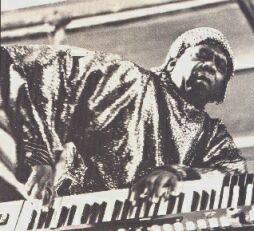 If Sun Ra brought jazz towards another direction, towards the stars, the
space and the infinite astral sonorities, towards avant-garde and
experimentation, today jazz doesn't exactly seem to be alive and thriving,
though its roots are often taken and reinvented by contemporary artists.
Primal Scream incorporated Sun Ra's astral tones in their dancey and angry
rock anthems as their track "Arkestra" on their latest album shows; Bill
Wells gives jazz a more experimental cut, jamming with different musicians
in freezing Scotland. The world goes on. The beat goes on. The jazz
transformed and reinvented goes 'somehow' on. "Today it is difficult to
label music," Lucio Fumo states, "so we must admit that the path all the
festivals took is not only dictated by the fact that stars such as Dizzy
Gillespie, Stan Getz and so on are dead, so that even if you wanted you
wouldn't be able to put together an exclusive jazz programme. Jazz has
become part of the world music, but there isn't a proper jazz today. There
are two things musicians do: either they play the old jazz, such as stuff
from Charlie Parker or they play today's music founding their rhythms on
the previous jazz but mingling them with the harmonies of today's music.
The result is that sometimes you get some horrible stuff and sometimes
interesting things. Whatever there aren't anymore the social conditions to
let that kind of music be born. I didn't go to New York in the '50s or '60s
but I went there 20 years ago for the first time and by then everything was
already over. Real jazz was born out of the frustrations of the musicians
who weren't admitted in the clubs because they were black, so they played
wearing glasses with their back to the audience and they made up that music
to keep people away from them. By now you don't have that kind of artists
anymore. For instance Wynton Marsalis has stopped at the old times and I
don't like his stuff. What Marsalis is doing now is a moniker of his
incapacity of doing new music. He had the misfortune of becoming rich and
famous too early. Marsalis plays tributes to Armstrong and Ellington but
his stuff doesn't work, whereas artists such as Pat Methiny play other
things and not real jazz."
If Sun Ra brought jazz towards another direction, towards the stars, the
space and the infinite astral sonorities, towards avant-garde and
experimentation, today jazz doesn't exactly seem to be alive and thriving,
though its roots are often taken and reinvented by contemporary artists.
Primal Scream incorporated Sun Ra's astral tones in their dancey and angry
rock anthems as their track "Arkestra" on their latest album shows; Bill
Wells gives jazz a more experimental cut, jamming with different musicians
in freezing Scotland. The world goes on. The beat goes on. The jazz
transformed and reinvented goes 'somehow' on. "Today it is difficult to
label music," Lucio Fumo states, "so we must admit that the path all the
festivals took is not only dictated by the fact that stars such as Dizzy
Gillespie, Stan Getz and so on are dead, so that even if you wanted you
wouldn't be able to put together an exclusive jazz programme. Jazz has
become part of the world music, but there isn't a proper jazz today. There
are two things musicians do: either they play the old jazz, such as stuff
from Charlie Parker or they play today's music founding their rhythms on
the previous jazz but mingling them with the harmonies of today's music.
The result is that sometimes you get some horrible stuff and sometimes
interesting things. Whatever there aren't anymore the social conditions to
let that kind of music be born. I didn't go to New York in the '50s or '60s
but I went there 20 years ago for the first time and by then everything was
already over. Real jazz was born out of the frustrations of the musicians
who weren't admitted in the clubs because they were black, so they played
wearing glasses with their back to the audience and they made up that music
to keep people away from them. By now you don't have that kind of artists
anymore. For instance Wynton Marsalis has stopped at the old times and I
don't like his stuff. What Marsalis is doing now is a moniker of his
incapacity of doing new music. He had the misfortune of becoming rich and
famous too early. Marsalis plays tributes to Armstrong and Ellington but
his stuff doesn't work, whereas artists such as Pat Methiny play other
things and not real jazz."
Few are the director of the Festival's regrets. "I was never able to see Billy Holiday and Charlie Parker live, neither did I manage to bring here Eric Dolphy, who is for me one of the three great legends of music, but I was lucky enough to see him in Paris. Anyway, these artists died before we started the festival and Luis Armstrong too. We managed to get here all the artists who were alive when we started, so we had Duke Ellington in 1970, Ella Fitzgerald in 1971, Miles Davis in 1973 and in 1986, Sarah Vaughan in 1984, Charles Mingus in 1972, Stan Getz in 1981..." his list is long and it seems it might go on for days on end. Well, with all these memories, Lucio Fumo should write a book about the Festival, "Sometimes I think about it and, well, I'll probably do it one day!" he enthusiastically replies. Before going away I ask Lucio Fumo if they already have any ideas for the 2001 jazz summer, "90% of the programme for the 2001 is ready," he smiles, but he's reluctant to mention any of the probable guests. Well, better to keep it as a surprise.
Yesterday I had a dream: in the dream I am sitting among the ruins of an ancient Roman amphitheatre, I am wearing a white gardenia in my hair a la Billie Holiday and I am reading a book. I am standing in the area deputed to be the stage and around me there are some scattered instruments, a saxophone, a horn, a trumpet, a flute, a piano, some bells and a harp. I'm reading aloud from the book, and when I pronounce the sentence 'Let them play', the instruments take a life on their own and their voice breaks off in a furious battle between the hierarchies of sounds. Like in a hallucinogens-inspired vision the words peel from the pages of my book and one after the other start flying around in the air, revolving around the instruments, their inky frames forming DNA-like chains of words. The words fluctuate next to the golden spaceship-like saxophone, the black piano, the ever beating drums and the horn. Other words unite little by little and, in their carousel, they seem to spell out the sentences Strange Fruit, Mainstem, Interstellar Space, Journey in Satchidananda, Space Is the place, Ecclusisatics, Bitches Brew. I'm mesmerised while looking at the words and listening to the music, the jazz jumping over the ruins, touching them and reaching the metaphysically blue sky, piercing the soft clouds. I realise that they are the titles of jazz compositions, and I try to grasp one of them, but right when I'm extending my hand to reach out for the words, I wake up in my room. The needle of the record I was listening is stuck in a groove, repeating the same note, repeating the same tone. I stand up, stretch, yawn and free the needle from its black prison. Outside the night is falling on the pallor of the town and an air plane is silently bleeping its lights in the distance. I lean on the window sill and look out: my neighbour, his back to his opened window, is playing his sax in this warm spring night too pregnant with expectations.
Pescara Jazz Festival Home Page: www.pescarajazz.com/en/





Copyright (c) 2005 erasing clouds |
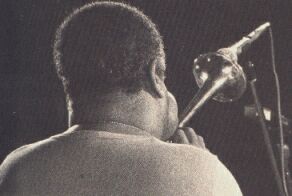
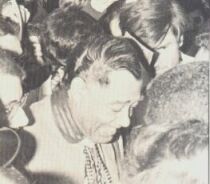
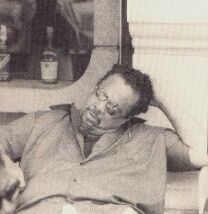
Dizzy Gillespie, Duke Ellington, Charles Mingus and Sun Ra's photographs, taken from the 25th Pescara Jazz Festival Anniversary Book - courtesy of
Lucio Fumo. |